You took the NREMT. You waited for your results. You refreshed your account more times than you'd like to admit.
And then you found out you didn't pass.

Now you're looking at a score that probably raises more questions than it answers.
What does that number mean? How close were you to passing? And what are you supposed to study now?
Let's talk about it.
Where to Find Your NREMT Test Results
Your NREMT results are usually available within three business days of taking your exam even though that seems like much longer.
To find them:
- Log into your account at NREMT.org.
- Select Candidate Role.
- Choose your application.
- Select Examination.
- Click Get Results.
If you passed, you'll see your passing result. If you didn't pass, you'll receive a score report.
Still Waiting for Your Results?
If you found this article while searching for signs that you passed the NREMT before your results are even posted, yes, we're looking at you.
Some people get their results within hours. Others wait a few days. Some get an email. Others find out by refreshing their NREMT account for the 47th time.
And then there are the conspiracy theories. Getting your results quickly means you passed. Waiting longer means you failed. Getting an email at a certain time means something.
Here's the thing: there's no reliable evidence that any of these are signs you passed or failed.
So, before you spend another hour on Reddit, Google, or Claude trying to crack the NREMT code, take a break. Your results will come when they come. Promise.

What Does Your NREMT Score Mean?
First, let's talk about that number.
The NREMT uses a scoring scale from 100 to 1500, with 950 as the passing point. This applies to both EMT and Paramedic exams.
And no, a score of 950 doesn't mean you need a 95% to pass.
Before you start doing math, here's what you need to know:
- 950 is the passing point.
- Below 950 means you did not pass.
- The scores are not a percentage.
- Your score does not tell you how many questions you got right or wrong.
How close were you to passing?
Let's say you scored a 920.
You're 30 points below the passing standard. But that doesn't mean you missed 30 questions.
Here's how a few example scores compare:
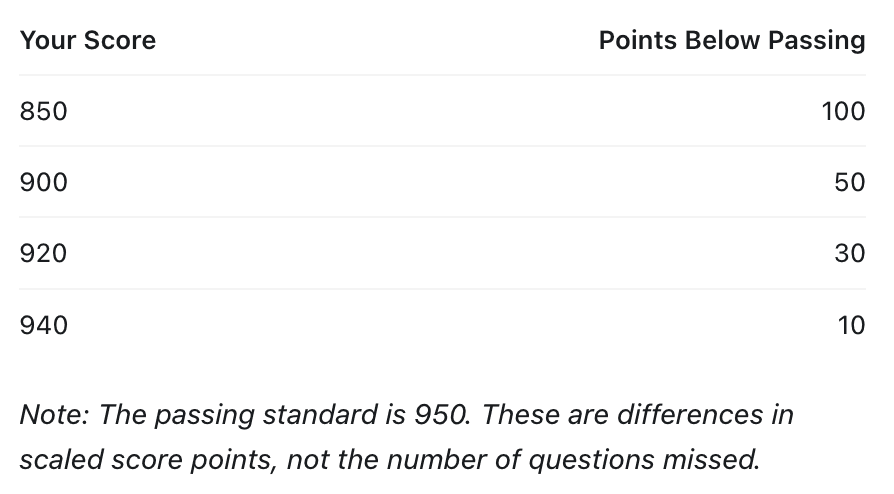
These are differences on the scoring scale, not the number of questions you missed.
So, if you're trying to figure out whether that one cardiology question ruined your entire exam, you can stop doing the math.
Your score report can't tell you that.
How to Read Your NREMT Score Report
Your score report gives you four main pieces of information:
- The application summary. The top of the report lists your certification level, application type, exam date and results date. The status line reads “Examination Scored.” That only means your exam has been graded. It doesn’t tell you whether you passed, so keep reading.
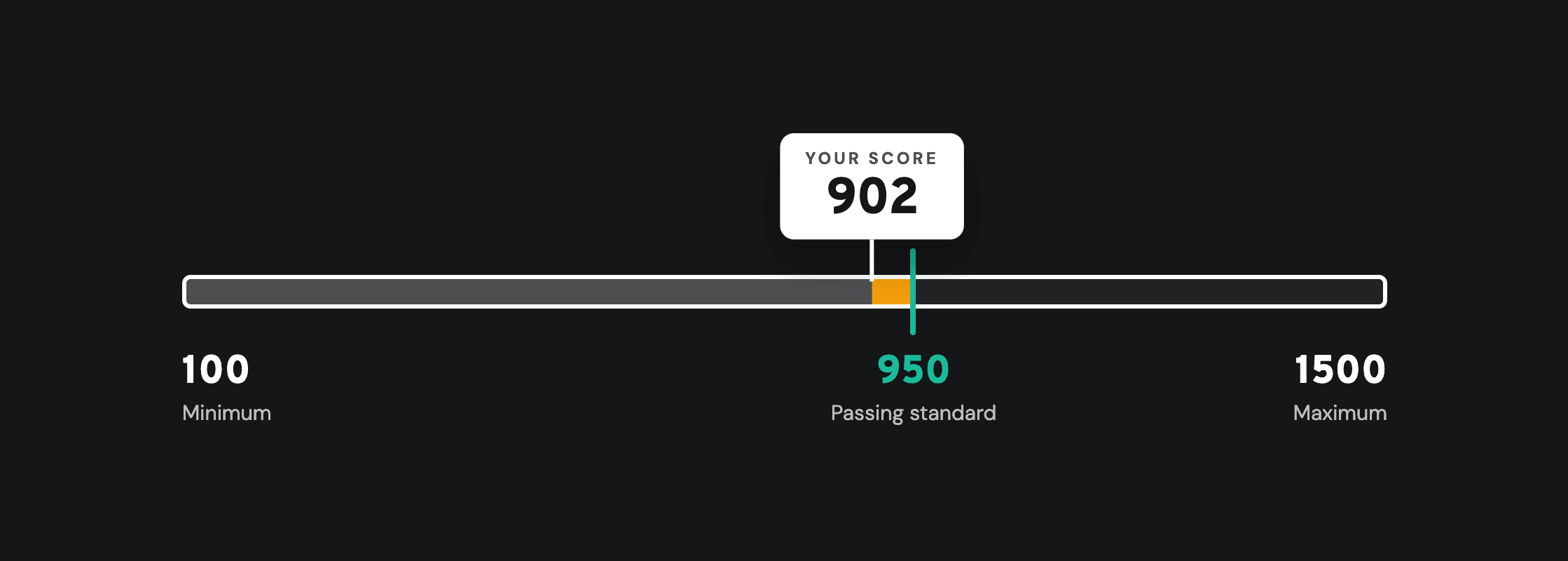
- The result sentence. This is where the report tells you that you didn’t pass, and states your score next to the 950 passing standard. Something like: your result was 902, which is below the passing standard of 950.
- The scale. A horizontal line running from 100 (the scale minimum) to 1500 (the scale maximum), with 950 marked as the passing standard and a “Your Score” marker showing where you landed. It shows you the distance at a glance.
- The summary lines. At the bottom, the same three numbers again: the scaled score range (100–1500), the passing standard (950) and your score. In this example, that’s 48 points below passing.
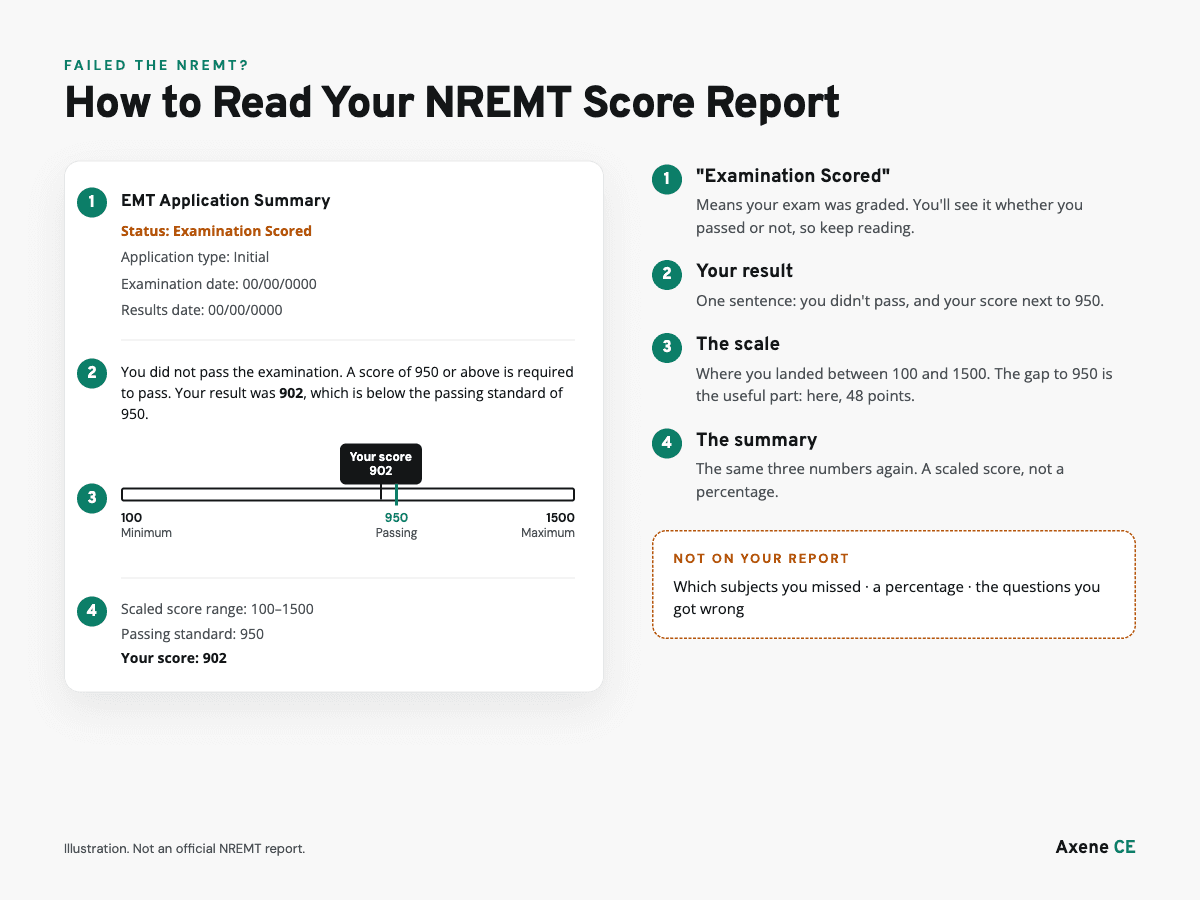
The report helps you understand how your performance compared to the passing standard.
What it doesn't tell you is exactly what went wrong.
Were you struggling with airway management? Did you miss something during a patient assessment? Were you overthinking the questions?
Your score alone can't answer those questions.
Does the NREMT Tell You Which Subjects You Failed?
Not in the current standard score report.
If you've been searching online, you might have seen people talking about these categories:
- Above Passing
- Near Passing
- Below Passing
- Those categories were part of an older NREMT reporting system.
Today, the standard report gives you an overall score instead of a breakdown of how you did in each subject. Yeah, we’re mad about it too!
So, if someone on Reddit tells you to study everything marked Below Passing, they may be referencing an older version of the report.
Which brings us to the big question...
Your Score Report Won't Tell You What to Study. Here's How to Figure It Out.
You've already taken the exam. You definitely don't want to start your entire EMT or Paramedic program over again.
You don't have to, but you do need to figure out where you're struggling.
1. Know what's on the exam.
Start with the current NREMT exam outline.
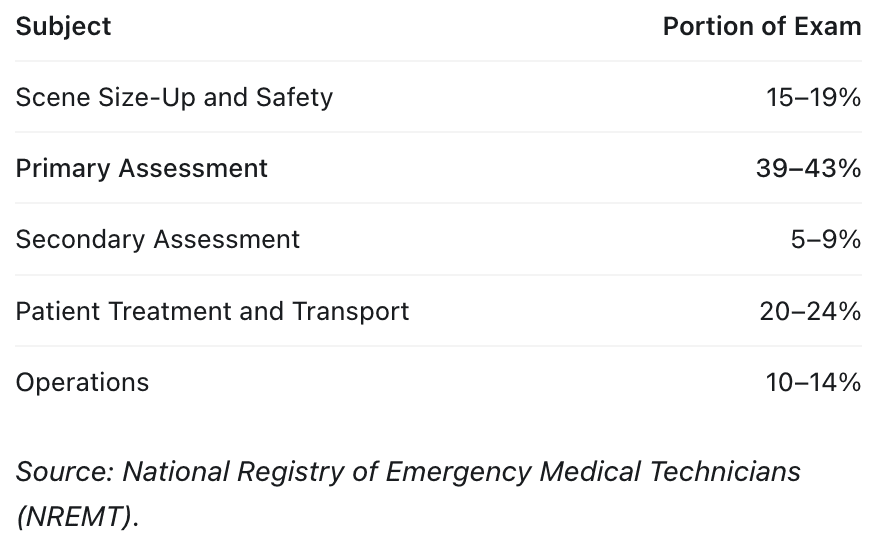
The National Registry publishes what each exam covers, and how much of the exam focuses on each area.
EMT Exam Content
Paramedic Exam Content
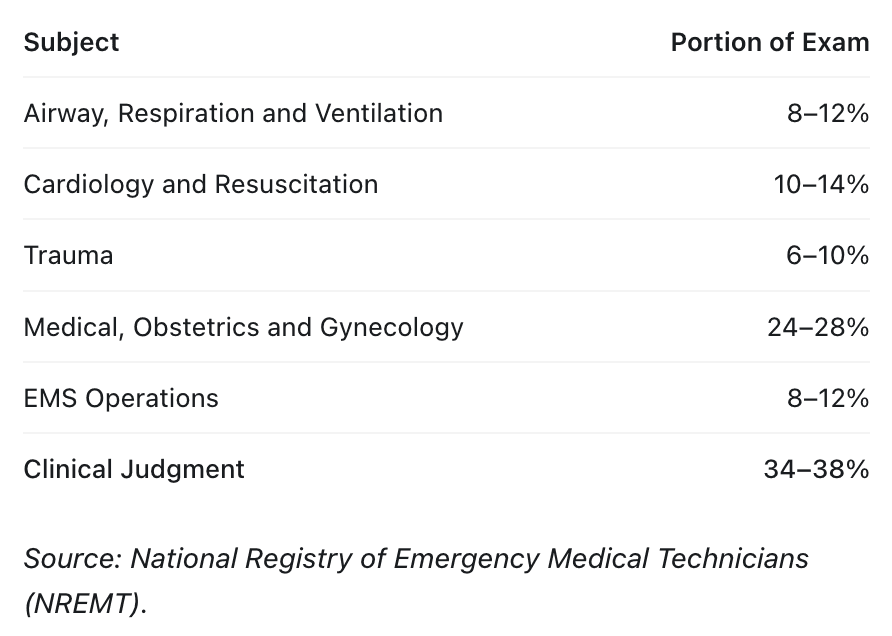
Notice how much of the EMT exam focuses on primary assessment.
And for Paramedics? Clinical judgment is a big deal.
Knowing what's on the exam can help you decide where to spend your study time. Just remember that every subject matters.
You can find the official exam outlines here.
2. Find your weak spots.
Start working through practice questions by subject.
Pay attention to which topics give you the most trouble.
Maybe you're great at trauma but struggle with respiratory emergencies. Maybe you know your medications but can't decide which one to give first.
Or maybe you've never met a cardiology question you liked.
Whatever it is, write it down.
The goal is to find patterns in your mistakes so you know where to focus.
3. Stop memorizing answers.
You've probably done this before.
You take a practice quiz, miss a question, look at the correct answer, and move on.
Then you take the same quiz again and get it right.
Great! But did you learn the material, or did you just remember that the answer was C?
When reviewing practice questions, ask yourself:
- Why is this answer correct?
- Why are the other answers wrong?
- What would change the answer?
- Could I explain this to someone else?
If you can explain why an answer is correct, you're in a much better place than someone who just remembers which button to click.
4. Keep track of what you're missing.
You don't need a fancy study planner. A notebook works just fine.
Start with something simple like this:
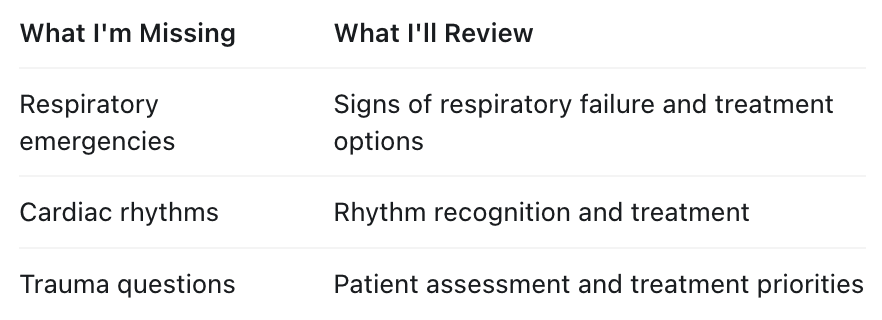
If you keep missing questions on the same topic, that's a good sign it needs more attention.
Study the material, then come back and try some new questions.
5. Practice making decisions.
Knowing the material is important. Knowing what to do with it is just as important.
Many NREMT questions ask you to choose the best action in a patient scenario and sometimes, more than one answer sounds right. Hence all of the NREMT test question memes.
Ask yourself:
- What is the biggest threat to this patient?
- What needs to happen first?
- What information am I missing?
- What is the question actually asking me?
Remember, the question may not be asking what you could do. It may be asking what you should do next. Or first.
There's a difference.
Make Your Practice Questions Work for You
Taking more practice questions can help. But only if you're learning from them.
Doing 500 questions without reviewing your mistakes isn't necessarily better than doing 50 questions and really understanding the answers.
It's about how you study, not just how much you study.
That's why Axene CE's NREMT Test Prep includes:
- 300 original EMT practice questions
- 300 original Paramedic practice questions
- Explanations for every answer (right and wrong)
- Test-taking tips and strategies from experienced EMS educators
Choose your certification level, practice the subjects you need to work on, and learn the reasoning behind each answer.
Because knowing why is a lot more useful than knowing the answer was C.
[Explore NREMT Test Prep]
How Soon Can You Retake the NREMT?
You don't have to wait months to try again.
The National Registry requires you to wait at least 15 days after your previous exam before retesting.
Here's what else you should know:
- EMT and Paramedic candidates have up to six attempts.
- After three unsuccessful attempts, remedial education is required.
- You must complete the required education before your fourth attempt.
Just because you can retest after 15 days doesn't mean you have to.
What happens if you fail the NREMT three times?
After three unsuccessful attempts, you'll need to complete remedial education before you can test again.
This is different from regular test prep.
Test prep helps you study and practice for the exam.
Remedial education fulfills a National Registry requirement, so you can become eligible for your fourth attempt. This needs to be a CAPCE-accredited NCCP course.
Axene CE offers remedial training for both EMT and Paramedic candidates.
[Explore EMT & Paramedic Remedial Training]
Your Next Attempt Starts Here.
Failing the NREMT isn't how you planned to finish your EMS education. We get it. No one wants to fail, especially multiple times.
But you don't need to spend the next two weeks staring at your score report. Use that time to figure out what needs work.
Find your weak areas. Review the material. Practice making decisions. Learn why the answers are right.
And when you're ready, give it another shot.
Sources
- National Registry EMT Candidate Handbook
- National Registry Paramedic Candidate Handbook
- National Registry Examination Content and Test Plans
Examination information and requirements are based on current National Registry guidance as of November 2026.